Monday, 22 June 2015

Engine Ancillaries Overhaul

At our last event at Rockingham we ended up beached in the gravel trap during the final race after the brakes locked and the ABS failed to kick in.

Whilst we initially suspected a failed brake master cylinder, the post race diagnosis was in fact that the alternator had failed.  There is no volt meter display on the Boxster dashboard (unlike its bigger brother 911) and the battery warning light seems to only come in some failures not all. It's not that surprising that the engine ancillaries tend to fail more often when the car is tracked.  With the engine running constantly at high rpm, they get harder use than they are designed for.

We have also been suffering from a leaking power steering pump caused by the vibration of the engine wearing the joint separating the reservoir from the pump.

Having to tackle one of these jobs is quite time consuming due to all the bits you have to remove to gain access. It made sense to change both ancillaries at the same time, making for a pretty long, days work.

There are always "whilst your in there" jobs on any Porsche, so we took the opportunity to fit an ancillary under-drive pulley.  This replaces the crank pulley driving the ancillary belt with a smaller diameter one. The benefit of this is that it slows the alternator, steering and water pumps by around 25% to give them more of a normal life.   As an added bonus, less energy driving the ancillaries in theory adds a few BHP to the engine output.

So drivers seat out, engine covers off, top of the air intake removed and you can at least get some access.  The roll cage makes it even more difficult though.


Tricky Access to Top of Engine with Roll Cage


Reading the factory manual and a few online forums gave us the insight that the alternator required a special procedure to remove it. A few large hammer blows in the right place and it was free it from its mounting. The power steering pump has a more delicate release mechanism for the hydraulic line which came out quickly too with the help of a second pair of hands.

Our car already has the air-con compressor removed which made access easier on the left side of the engine bay.
Ancillaries Removed
Small Under-Drive Pulley


After cleaning up the power steering fluid; which was everywhere, and quite a lot of stones which somehow got on top of the engine.  Don't go in the gravel traps!.  Final refitting included a new shorter drive belt to fit the smaller pulley.

Hopefully this sets up us for a good, trouble free performance in July at Donington Park.

Thursday, 11 June 2015

Rockingham Race TV

We featured heavily in the Motors TV coverage after going from 11th to 4th in Race 1 at Rockingham.


Wednesday, 20 May 2015

2015 Season Starts at Rockingham Speedway

We made the trip up to Corby to the Rockingham Speedway for our first event of the 2015 season. The outer paddock is not the most glamorous of places on the BRSCC Calendar, but we made do, setting our trailer down alongside some of the other drivers who run with race trucks and awnings.  Many had tested the day before, but were remaining tight lipped about how they'd got on!

Scrutineering completed without a hitch  which is always good.  And at 10:30am on the Saturday we headed round to the infield section and out onto the track for 20mins of Qualifying.

I immediately realised something was not right with the engine.  Erratic idling in the holding area escalated to hesitation every time I went between 5000-6000 RPM.  Intermittent at first, I headed back to the pits as red flags came out for an accident.  A quick chat in the pits decided there was nothing we could do, and with the track back open I headed back out.  Using a higher gear round some corners and gingerly taking the banked oval track section (usually flat out at 110mph) I qualified 11th 2secs off my expected pace.
Picture: Chris Valentine (88-racing.com)
Back in the paddock we immediately found the airbox was broken causing erratic air flow past the Mass Air Flow sensor (MAF).  An extra jubilee clip solved the problem and will ensure it doesn't return.  

Feeling confident that the car was now running fine and with a slight suspension tweak to dial out some over-steer I went out for Race 2 on Saturday afternoon.  

I climbed 3 places on the opening lap.  A couple of cars spun off under pressure, falling to the back, whilst another two collided bringing out the safety car.  Running in 4th place, eying up a first ever podium, I spun up the rear tyres too much as the safety car pulled off and this led to loosing a place a lap later.  A three-way battle for 3rd place finished with me reclaiming 4th for my best ever finish.  

Race 1 Video


A great social event and BBQ was put on that evening in the paddock before we headed off to the hotel. 

On Sunday I had to add the obligatory "Championship Success Ballast" which was 20kg's for my 4th place finish.  This took me to 50kg's over the minimum weight so I still need to lose some more from somewhere.  


The two races didn't quite go to plan.  A poor start in Race 2, left me high on the outside of the banked first corner.  Another car tried to go higher in my blind spot and we collided as the pack of cars ran out to the wall of the track. I got lucky with a slight dent and an unbalanced wheel, whilst the other car sustained lot of damaged with the wall.

The final race started reasonably, although I lost a lot of places off the grid (reversed so I started 2nd).  Then on lap 2, my brake pedal went solid and I careered off into the gravel for a rare DNF.
Smoke from locked brakes - heading off into the gravel


A weekend of highs and lows.  Another situation where we managed to resolve technical problems with the car ourselves.  On the down side we absolutely need to fix the power steering pump which continues to leak, and likely also need the alternator replaced (potential cause of ABS failure).

Two outstanding additional performance modifications are also overdue; GT3 suspension arms, which will increase corner grip plus the under-drive pulley to slow the ancillaries and increase power a little. 

Next race for us is Donington Park in July.


Thursday, 26 February 2015

Monday, 23 February 2015

Winter Upgrades and Servicing

Three years of racing is starting to take its toll on the Boxster with some wear and tear items needing to be addressed. 

The leaking power steering fluid has been fixed by replacing the o-ring seals between the reservoir tank and the pump.  Access is very tight on top of the engine so we're hoping a full replacement is the pump isn't needed.  

All four brake calipers have been sent away for a full refurbishment. The diagnosis from Pro Calipers was that they have been over heating significantly.  All the rubber seals were disintegrated and the paint color darkened to a deep red indicating temps of 300c+. Disintegrated seals prevents the pads retracting fully, increasing wear and heat and ultimately slowing us down.  

The refurbishment included new bleed valves, seals, anti squeal shims and we also fitted the Goodridge braided hoses.  The latter having sat on the "To do" list for over two years.   

At the front of the car we've replaced the centre radiator which along with its bracket was on its last legs. 

Whilst the front bumper was off we've added brake cooling ducts, forcing air through the front bumpers and onto the brake discs.  This adds to the GT3 ducts fitted towards the end of last season as an attempt to keep brake temps down.

In the engine we re-attached the the exhaust with new clamps.  The exhaust falling off was the ultimate reason for my DNF at Donington last October.  It must have been knocked on the kerb going into or out of the gravel trap, but took another 10mins to properly fall off.  

We needed a new inner wheel arch liner which had melted on the exhaust. 


A full oil change, brake fluid flush with 2 litres of Castrol SRF and the BMC performance air filter cleaned and recharged completes the regular service items.  


Friday, 12 December 2014

Running Your Own Race Car...How Hard Can It Be!

To some, the idea of running your own race car may seem daunting.  There are obviously different approaches available from doing everything yourself, through to getting someone to do everything for you, plus plenty of options in-between.  

We built our Race Porsche Boxster ourselves with the intent of running it ourselves.  The building was part of the fun and experience.  Never having done anything like this before was a challenge, took more time than anticipated, but it's the only way we can afford to compete. 

If the car is reliable, well put together and you are well prepared, then running yourself over a race weekend is very achievable and also rewarding.  

The work isn't complex, even for people less mechanically minded.  If you can jack up a car and change a wheel or your own brake pads, it's well within the capability of a driver and an extra pair of hands to help.

In order to make a race weekend manageable, the car needs to be prepared as much as possible before each event.  There is enough to do with registration, scrutineering and sorting yourself as a driver out when you arrive at the circuit.

The car needs to be ready; good enough to qualify, straight after unloading from the trailer. This typically means fueled for qualifying, battery charged, brakes cleaned, belts adjusted and roll bars/suspension setup to the baseline for the track or the outcome of any practice days. Just tyre pressures to set and go! 
Car fully prepared and ready to qualify

To make things easier the car setup and ambient conditions for every session on every track are logged in a spreadsheet we keep.  This is for use as a reference between sessions and also for the future.  This has been invaluable in saving time and giving a good baseline to work from when turning up somewhere new or when the conditions change unexpectedly.

With the car ready, it's just a case of having my race suit and boots on and gloves, balaclava and helmet in the car.  Typically this is around one hour before the race time (30-40 mins before we are called to the holding area.)  This is in case it rains or conditions change, leaving plenty of time to sort anything out on the car. Trying to get the car and yourself ready at the last minute just isn't possible unless you have a team of people supporting you. 

Tyre pressures are set higher than needed beforehand so it's just a case of releasing air down to the desired pressure at the last minute.

I drive myself to the holding area, and tend to wait in the car, engine running/warming up. There is an order to putting balaclava, helmet, safety belts on.  Then setting my lap-timer and finally putting my gloves on, since I can’t reach the dashboard once belted in.  This year I have an automatic car camera which records all the time the ignition is on, which means one less thing to worry about too. 

Once we come off the track, if onsite fuel is open the car can be driven there and refueled straight away to save time and effort.  Otherwise jerrycans are used, but this is still typically the first job to do.  You also need to give the car some time to cool down!
The pit garage for the weekend - Driver and Chief Mechanic

Before and during each race weekend the following work is typically needed:

Battery: The race battery needs to be trickle charged overnight before each event.  We also make sure the engine is running when using the 12v tyre compressor as it doesn't take much to deplete the battery.

Race Harnesses:  Harnesses need to be checked and adjusted before each event.  To check for wear and tear and to re-adjust as needed.

Anti-roll Bars: We set these per circuit before each event, and typically don't then change them unless is rains heavily or I have time to experiment with a different setup.  Takes 5 mins per side with an allen key and spanner with the wheels on.

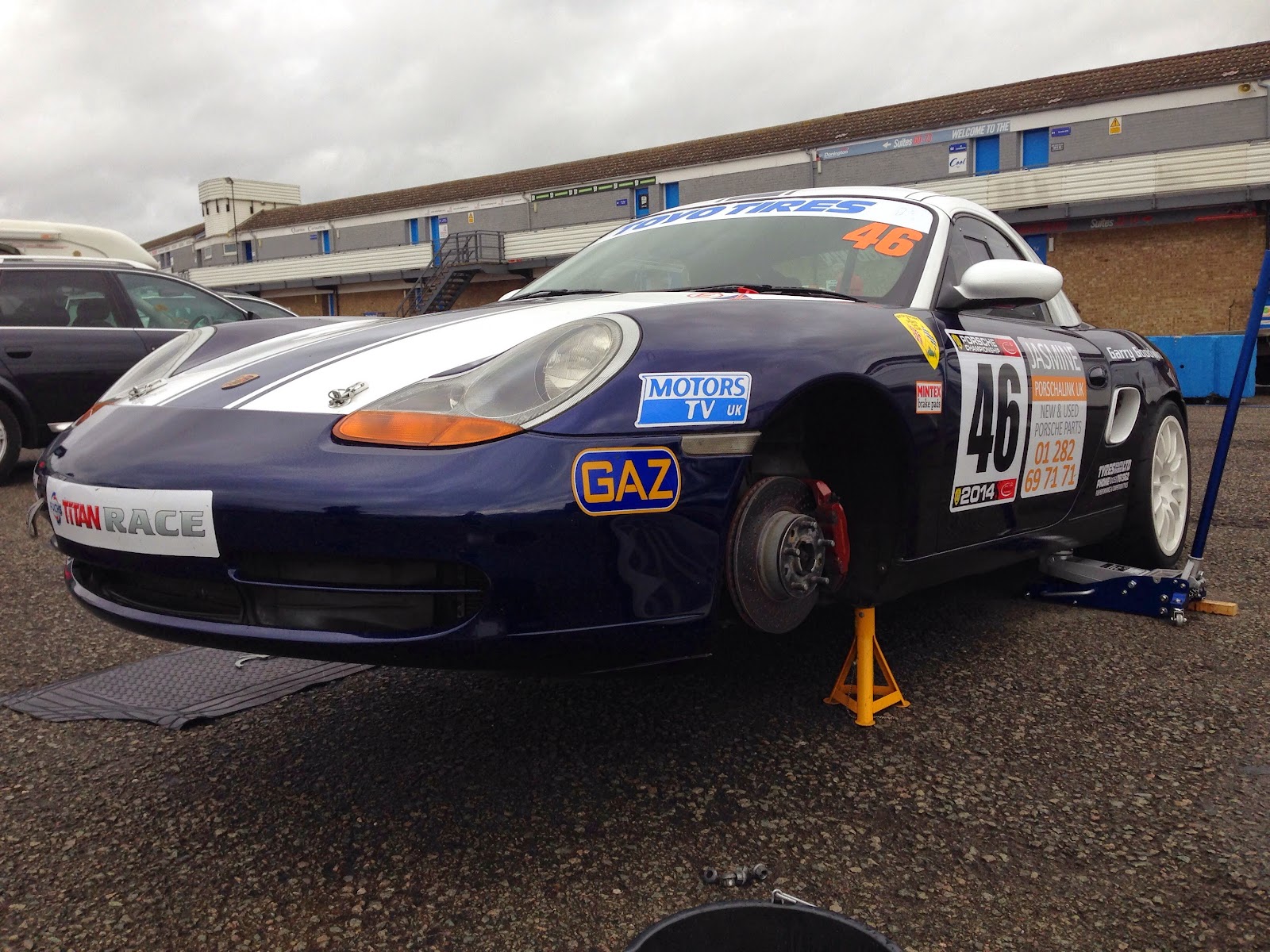
Brakes:  The drilled discs get clogged up with brake dust and need to be cleaned out after every two track sessions. Takes 10 mins per corner.   We typically replace the brake discs at the same time as the pads get to 3/4 worn.  Brake pads are lasting at least 3-4 events on the front, but twice that on the back.
    
Wheels:  While the brakes are being cleaned its a good time to clean the rubber marbles off each wheel. Wheel bolts have been changed to studs and a cheap 12v impact gun helps to speed up removal and refitting. Then tighten with the torque wrench.

Suspension Stiffness: This is set before each event to a baseline for the circuit. A decision is made after each session on track as to stick or change, based on the weather or to address over or under-steer issues. Takes 1 min per corner to twist the adjuster knob and can be done with wheels on.
I have even adjusted this in the holding area minutes before the race when it has unexpectedly poured with rain.

Tyres:  Tyre pressures are critical.  Too low and you have no grip until they warm up.  Too high and they overheat, get greasy and loose grip into the race.  Pressures change with the ambient temperature and conditions, hence our historical log is used as a guide. Usually the last thing to be set before going out onto track and takes 30 secs per wheel.

Oil/Brake Fluid/Servicing: As we only typically do 4-5 event per year this is limited to the off-season. No point in changing oil every event / 150 miles. If we did a full season then a service mid way would be sensible.

On axle stands during cleaning of front brake discs and wheels


Most changes or minor problems can be tackled with a decent home mechanic tool set. The bulkiest items travel in the race car and the rest in the car boot.
  • A decent low entry jack
  • Axel stands
  • Tyre pressure gauge
  • 12v Tyre compressor
  • Set of screwdrivers, socket set and ring spanners
  • Set of hex/torx bits (Porsche put them everywhere)
  • Brake caliper hex socket bit
  • Hose clip tool
  • Hand wipes, bucket and car cleaning kit
  • 12v impact gun
  • Torque wrench
  • 2x Jerry cans plus funnel
  • Cable tie, Duct tape / Electrical tape
  • Spare fuses and a spare 9v fire extinguisher controller battery
  • Mat to lay on and an Umbrella to keep some rain off!
Car boot used to store tools over the weekend.
If you need anything else then you have a bigger problem to solve.  Once or twice we have needed help from other people in the paddock to fix a problem and keep us racing.  Generally people are always willing to assist.  The presence of a championship parts supplier means we don't need to carry any specific spare parts. 

Of course if you end up in the gravel, having a mechanical failure or getting damaged (all of which have happened) you will need more time to sort the car out. This is when being organised and having an extra pair of hands is the difference between getting out for the next race or going home.  

The methodical approach to preparation and maintenance has contributed to the fact we have only suffered two DNF's in three seasons.
  1. The last lap of a race, when the gear selector broke.  In hindsight I could have limped home in 4th gear!
  2. When the exhaust broke off, causing fumes in the cab due to being knocked over the kerb coming out of a gravel trap after going off on an oil spill.
We have never had to go home early or miss a race we wanted to enter. 
 
So it's not that difficult if you are well prepared, and is extremely rewarding, especially when you out-perform those who have bigger budgets and professional support.